Just went to Kimballs for strawberries (3.50/small box), and they also had:
Garlic scapes (5.99/lb)
Green garlic, green onions (young onions), and scallions (1.99/bunch)
Heirloom tomatoes and cherry tomatoes ($4/box, obviously hothouse)
Diva cucumbers (2.99/lb, hothouse?)
Various greens (1.99/bunch) - no broccoli raab in evidence this time, probably just sold out
Rhubarb (2.49/lb)
Got a little of everything for $24, half of which was strawberries.
Wednesday, June 18, 2014


miti cana de oveja
I'll get a photo when I do a larger multi-cheese post, but I wanted to post about Miti Cana de Oveja, a Spanish cheese from Lorenzo Abellan. This is a fantastic cheese.
This week I made my annual birthday-celebratory shopping trip to Wegmans, returning with about a dozen different cheeses, most of them new to me (in addition to fresh wild halibut, flounder, grey sole, and monkfish; dry-aged steaks; MezzoMix soda from Germany; Kinder chocolates; Hartmann hot dogs; and Vegemite). We tried three of the cheeses last night - all three were fantastic, and all three will be blogged about.
But Cana de Oveja (I see it written without the "Miti" more than with, when I googled for information about the cheesemaker) is something of a Holy Grail cheese for me. For a long time, I've wanted to find "a sheep cheese that's like a goat cheese," meaning a young soft sheep's milk cheese that was like the sheep's milk equivalent of chevre. It's surprisingly hard to find, and I don't know enough about making cheese from sheep's milk to guess why. Sometimes traditions are just traditions - you probably could make mozzarella from goat's milk instead of cow's or water buffalo's, for instance, but you don't because those aren't the farmers who first made it.
Anyway, this is my cheese. This is the cheese I've been looking for! It looks exactly like a bucheron - a bloomy-rinded log with a thin brie-like layer surrounding the chalky white core - and it is so, so good. It's tangy, it's milky, and above all, it's sheepy. "Sheepiness" is a milder thing that "goatiness," but it's its own thing too - it's not "goaty, but less so," it's sheepy, and that's exactly why I've been searching for a cheese like this.
Instant favorite. Probably the best non-American young cheese I've had. I'm looking forward to trying it with some fruit or honey. Caitlin liked the richer, less tangy Castelbelbo, a mixed-milk from Italy, more than this, so perhaps I'll construct our cheese plates accordingly in order to sneak the lion's share of this stuff for myself.
This week I made my annual birthday-celebratory shopping trip to Wegmans, returning with about a dozen different cheeses, most of them new to me (in addition to fresh wild halibut, flounder, grey sole, and monkfish; dry-aged steaks; MezzoMix soda from Germany; Kinder chocolates; Hartmann hot dogs; and Vegemite). We tried three of the cheeses last night - all three were fantastic, and all three will be blogged about.
But Cana de Oveja (I see it written without the "Miti" more than with, when I googled for information about the cheesemaker) is something of a Holy Grail cheese for me. For a long time, I've wanted to find "a sheep cheese that's like a goat cheese," meaning a young soft sheep's milk cheese that was like the sheep's milk equivalent of chevre. It's surprisingly hard to find, and I don't know enough about making cheese from sheep's milk to guess why. Sometimes traditions are just traditions - you probably could make mozzarella from goat's milk instead of cow's or water buffalo's, for instance, but you don't because those aren't the farmers who first made it.
Anyway, this is my cheese. This is the cheese I've been looking for! It looks exactly like a bucheron - a bloomy-rinded log with a thin brie-like layer surrounding the chalky white core - and it is so, so good. It's tangy, it's milky, and above all, it's sheepy. "Sheepiness" is a milder thing that "goatiness," but it's its own thing too - it's not "goaty, but less so," it's sheepy, and that's exactly why I've been searching for a cheese like this.
Instant favorite. Probably the best non-American young cheese I've had. I'm looking forward to trying it with some fruit or honey. Caitlin liked the richer, less tangy Castelbelbo, a mixed-milk from Italy, more than this, so perhaps I'll construct our cheese plates accordingly in order to sneak the lion's share of this stuff for myself.
Tuesday, June 17, 2014
smoked chicken salad
Of all the various "chop this up and add mayonnaise" "salads," egg salad is the only one I grew up liking. Tuna salad in particular I just can't stand, and all the other "salads" are too often made gloppy with too much mayonnaise. I never order them out.
But I love chicken salad if I make it myself.
I probably started making it because I love to roast a chicken, and that leads to leftovers. Plus, in Indiana, my butcher used to sell smoked chickens, which made some pretty amazing sandwiches. Of course, now I have a stovetop smoker. To smoke your own chicken (with non-crispy skin, I'm afraid), butterfly it, put it in a stovetop smoker for about an hour, and finish it by putting the smoker in the oven for another 30-40 minutes. (It seems to cook too slowly if you cook it entirely on the stove, which means a dried-out breast.)
So:
One smoked chicken, bones and skin and tendons removed, torn into bite-size pieces.
Mayonnaise. Duke's preferably, Blue Plate is fine, Yankees will probably have to resort to Hellmanns. I am a fanatic about Duke's. It has no sugar or other sweetener, which is really key. It's like the opposite of Miracle Whip.
Tony Chachere's seasoning mix.
3 hard-boiled eggs.
The greens from one or two bunches of radishes, depending on how big they are.
A little onion, green onion, or pickled ramp.
Wash the greens very thoroughly, drop them in boiling water for thirty seconds, plunge them in ice water, and squeeze all the water out of them - when they seem dry, wrap them in paper towels and squeeze again. Chop finely, wrap in paper towels AGAIN, and squeeze again. You don't want watery chicken salad!
Chop hard-boiled eggs and onion.
Now add everything together, and use only as much mayonnaise as it takes to get the egg and chicken to stick together. No more! It's like macerating strawberries in a little sugar, versus suspending them in jelly.
Watercress can be great in there too, or a couple chopped radishes.
But I love chicken salad if I make it myself.
I probably started making it because I love to roast a chicken, and that leads to leftovers. Plus, in Indiana, my butcher used to sell smoked chickens, which made some pretty amazing sandwiches. Of course, now I have a stovetop smoker. To smoke your own chicken (with non-crispy skin, I'm afraid), butterfly it, put it in a stovetop smoker for about an hour, and finish it by putting the smoker in the oven for another 30-40 minutes. (It seems to cook too slowly if you cook it entirely on the stove, which means a dried-out breast.)
So:
One smoked chicken, bones and skin and tendons removed, torn into bite-size pieces.
Mayonnaise. Duke's preferably, Blue Plate is fine, Yankees will probably have to resort to Hellmanns. I am a fanatic about Duke's. It has no sugar or other sweetener, which is really key. It's like the opposite of Miracle Whip.
Tony Chachere's seasoning mix.
3 hard-boiled eggs.
The greens from one or two bunches of radishes, depending on how big they are.
A little onion, green onion, or pickled ramp.
Wash the greens very thoroughly, drop them in boiling water for thirty seconds, plunge them in ice water, and squeeze all the water out of them - when they seem dry, wrap them in paper towels and squeeze again. Chop finely, wrap in paper towels AGAIN, and squeeze again. You don't want watery chicken salad!
Chop hard-boiled eggs and onion.
Now add everything together, and use only as much mayonnaise as it takes to get the egg and chicken to stick together. No more! It's like macerating strawberries in a little sugar, versus suspending them in jelly.
Watercress can be great in there too, or a couple chopped radishes.
Monday, June 9, 2014
green strawberries
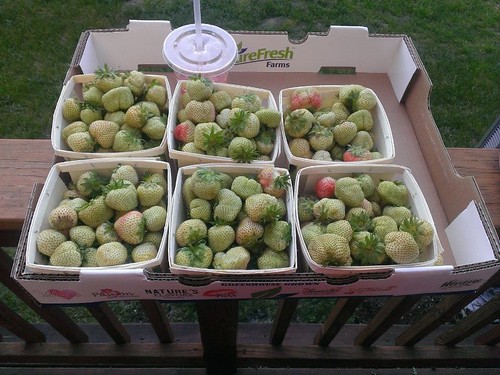
Green strawberries aren't a new breed of strawberry like pineberries, they're exactly what they sound like: unripe strawberries. You see them once in a while at some farmers markets, but they're not nearly as common as green tomatoes or chiles - I had to make arrangements with Kimballs to have them picked for me.
The green is really attractive - a sort of ivory green before it starts to yellow as it ripens to red - though that color does not survive cooking the way the deep red of ripe strawberries does. This ivory color is actually a sort of intermediate stage - if you're picking your own, let the strawberries grow a bit to reach this stage rather than picking the fruit as soon as it appears. Those earlier green-green or "unripe unripe" as opposed to "ripe unripe" strawberries are harder with less flavor.
Why use green strawberries? Purely as a change of pace and to better understand the strawberry. It's not like with tomatoes, where cooking green tomatoes is a good way to deal with the glut of red tomatoes you would otherwise have, or a way to use those tomatoes you get at the end of the season that won't have time to ripen.
However, there are some similarities to green tomatoes, mainly that, compared to ripe strawberries, green strawberries are firmer and more tart. The strawberry flavor is still there, just fainter and without the sugar to bring it out. There's another flavor too, which I guess is the flavor of the chlorophyll or whatever's making them green, a flavor that goes away when the strawberry ripens.
So what do we do with these.
The first thing I did was macerate some overnight with some sugar to make preserves - same basic method I use for ripe strawberries: macerate overnight, heat up until they just start to soften, turn off heat, let sit overnight, add more sugar and boil until jam-thick.
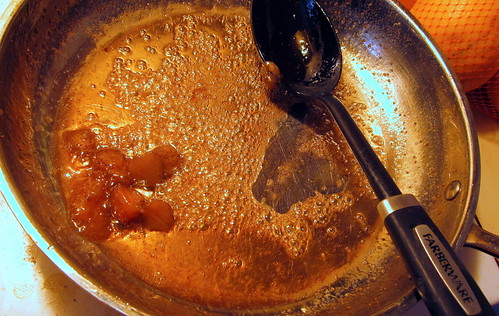
The ivory green is gone. The syrup of the jam is a color somewhere between golden raisins and cream soda, and the chunks of fruit show up in colors the paint swatch people might call Sun Belt Peach, Burnt Mountain Dew, and Foreclosed Lawn. It's a tart jam, but it's also surprisingly complex in flavor - far more than green tomatoes can yield, for instance, another difference there.
I've got more green strawberries in a jar of whiskey to make green strawberry bounce, some mixed with rhubarb for a pie, and some macerating in sugar to make green strawberry shrub. Tonight we'll have sliced raw green strawberries in salad and see how that goes.
Friday, June 6, 2014
farmstands 6-6-14
Finally the produce season is getting going. We've got our garden set up - tomatoes, fennel, and greens are doing great, lime basil mysteriously died, lovage and lavendar and sorrels (red and green) are doing pretty well. I just transplanted a Cuban oregano plant that the jury's still out on.
Rhubarb has come and will soon be gone at my mother's. By far the best thing I've done with it is this cake. Yes it has Jello. Yes it has marshmallows. It is fantastic.
The first local vegetables are starting to show up: radishes at Lull's today, green onions and broccoli raab (so much younger and sweeter than supermarket raab!) at Kimballs last weekend, and Caitlin picked up microgreens and white Japanese turnips (hakurei?) at the Copley Square Farmers Market today. I haven't tried those yet because she's actually not home yet, but turnips are wildly underrated, and I'm intrigued at trying a new-to-me variety.
This is also a good time of year for us (and anyone in this part of New England) to keep an eye on Valicenti Organico, a local (six minutes away from me) producer of pastas and sauces. We buy their ravioli regularly, which leans heavily on local fruits and vegetables. The ratatouille ravioli is one of my favorites, but at the moment we have two that we haven't tried yet: artichoke and boursin, and even more excitingly, pea tendril with grilled ramps and local mushrooms, which is three of my favorite vegetables in one ravioli.
It'll be another couple weeks before strawberries - I've requested some green strawberries from Kimballs in the meantime - and a few weeks after that before blueberries and early season vegetables. Tomatoes, forget it, not for ages.
Rhubarb has come and will soon be gone at my mother's. By far the best thing I've done with it is this cake. Yes it has Jello. Yes it has marshmallows. It is fantastic.
The first local vegetables are starting to show up: radishes at Lull's today, green onions and broccoli raab (so much younger and sweeter than supermarket raab!) at Kimballs last weekend, and Caitlin picked up microgreens and white Japanese turnips (hakurei?) at the Copley Square Farmers Market today. I haven't tried those yet because she's actually not home yet, but turnips are wildly underrated, and I'm intrigued at trying a new-to-me variety.
This is also a good time of year for us (and anyone in this part of New England) to keep an eye on Valicenti Organico, a local (six minutes away from me) producer of pastas and sauces. We buy their ravioli regularly, which leans heavily on local fruits and vegetables. The ratatouille ravioli is one of my favorites, but at the moment we have two that we haven't tried yet: artichoke and boursin, and even more excitingly, pea tendril with grilled ramps and local mushrooms, which is three of my favorite vegetables in one ravioli.
It'll be another couple weeks before strawberries - I've requested some green strawberries from Kimballs in the meantime - and a few weeks after that before blueberries and early season vegetables. Tomatoes, forget it, not for ages.
chicken riggins
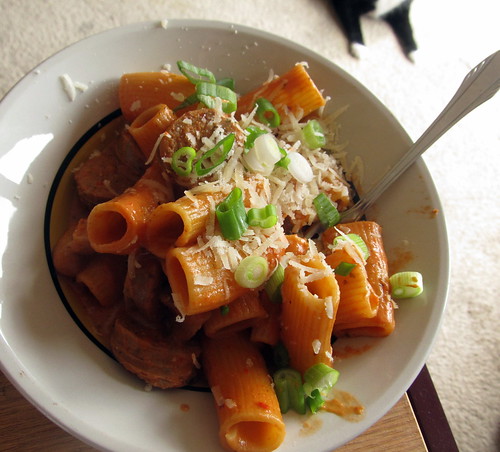
I was aware of, but had never had, chicken riggies - an upstate New York dish of chicken and rigatoni with a creamy tomato-pepper sauce. But I added some sausage to mine and named it after Caitlin's favorite football player. Very good stuff, very flavorful, and made good leftovers for lunches.
Chicken Riggins
1 can (28 oz) San Marzano tomatoes. San Marzano tomatoes are rich, low-acid plum tomatoes, which are perfectly-suited to long-cooked red sauces like this one.
2 red bell peppers, stem/ribs/seeds removed.
3 cloves garlic.
1 small onion, chopped.
1 tablespoon sriracha or similar hot sauce (no vinegar, no lemon, no cumin)
1/4 cup dry vermouth
1/2 cup heavy cream
salt and herbs to taste - marjoram, oregano, fennel
4 chicken thighs, just the meat, chopped. You can often buy boneless skinless chicken thighs, but I would get the bone-in skin-on kind and make stock with what you don't use.
4 green onion sausages
rigatoni
fresh parmesan, grated, and green onions, sliced. We both agreed that using the good parm made a noticeable difference here.
Simmer the tomatoes, bell peppers, garlic, onion, sriracha, and dry vermouth together, covered, until the vegetables are very soft; blitz with immersion blender, cook down uncovered, slowly, until thick; add cream and seasonings, cook another half hour, and adjust seasonings if needed.
Meanwhile, toss the chopped chicken with a little Tony Chachere's seasoning salt and saute until cooked. Cook sausage links and slice. Drain fat if necessary and add meats to sauce.
Cook the rigatoni, finishing it in the red sauce the last 2 minutes, and serve with parmesan and green onions.
Chicken Riggins
1 can (28 oz) San Marzano tomatoes. San Marzano tomatoes are rich, low-acid plum tomatoes, which are perfectly-suited to long-cooked red sauces like this one.
2 red bell peppers, stem/ribs/seeds removed.
3 cloves garlic.
1 small onion, chopped.
1 tablespoon sriracha or similar hot sauce (no vinegar, no lemon, no cumin)
1/4 cup dry vermouth
1/2 cup heavy cream
salt and herbs to taste - marjoram, oregano, fennel
4 chicken thighs, just the meat, chopped. You can often buy boneless skinless chicken thighs, but I would get the bone-in skin-on kind and make stock with what you don't use.
4 green onion sausages
rigatoni
fresh parmesan, grated, and green onions, sliced. We both agreed that using the good parm made a noticeable difference here.
Simmer the tomatoes, bell peppers, garlic, onion, sriracha, and dry vermouth together, covered, until the vegetables are very soft; blitz with immersion blender, cook down uncovered, slowly, until thick; add cream and seasonings, cook another half hour, and adjust seasonings if needed.
Meanwhile, toss the chopped chicken with a little Tony Chachere's seasoning salt and saute until cooked. Cook sausage links and slice. Drain fat if necessary and add meats to sauce.
Cook the rigatoni, finishing it in the red sauce the last 2 minutes, and serve with parmesan and green onions.
Friday, May 9, 2014
what we blog about when we blog about butter
I keep saying "I need to blog about this, I need to blog about that," and never getting around to it, so here are some half-formed thoughts on butter that I haven't had a chance to follow through on yet:
THOUGHT 1: A couple weeks, maybe a couple months ago, I read about a chef who had made butter by combining cream with a soft ripened cheese (Camembert maybe?) in a 9:1 ratio, let the cream culture, and then churned it. I don't know exactly how Camemberty (maybe?) the butter came out, or if the cheese is just used as the source of the culture to culture the cream, BUT. It got me thinking about ways to manipulate cream before you churn it.
I've made butter before. I first started buying good dairy when I moved to Indiana and the farmers' markets (and many local stores) carried it, about 11 years ago now (geez). Good pasteurized cream makes decent butter and is a good exercise; cultured cream (adding a little buttermilk and letting it sit at room temp overnight) makes even better butter, though pasteurization does make it a little resistant to culturing. Anyway, if you have an immersion blender, making butter is as simple as whipping cream and continuing to whip it until it breaks into solid butter and liquid whey. If you don't have an immersion blender, well, it's still that simple, your arm will just be more tired.
So when thinking about ways to manipulate cream pre-butter, there are two limits you have to impose:
1a: The cream still has to be able to be turned into butter. That means you can't do anything that'll curdle it, like adding lemon juice, and you can't dilute the fat content (you can whip milk all day and you won't get butter, just warm milk). Does it mean you can add a liquid as long as you keep the fat percentage the same, such as by adding bacon fat? I don't THINK so, but I don't know for sure. If you add another fat, will it end up as part of the butter or leak out with the whey? I don't know that either.
1b: There is no point in manipulating the cream towards a different butter if you can get the same results by manipulating the butter. For instance: you can add cinnamon to cream and whip it into butter, but it won't be different from, or better than, adding cinnamon directly to butter. This is particularly key when you're forced to use pasteurized cream, because it means the best storebought butter is better than your homemade butter, so the best manipulated butter will only result from manipulated cream when manipulating the cream is the only way to reach the final product in question.
I think there are three basic forms of cream manipulation to be considered and explored: adding an ingredient (cheese, for instance), infusing the cream with an ingredient that is steeped and then removed (bay leaves, for instance), and changing the cream by other means (such as by smoking it or culturing it).
I thought about ramp butter made from ramp-infused cream, which invokes the 1b issue: will this be different from ramp butter made with ramps added directly to butter? Yes. Will it be significantly different? I don't know. Will it be better? I don't know. Even moreso that garlic, ramp mellows out when it cooks. We could be talking about something surprisingly subtle here.
THOUGHT 2:
This led to a consideration of fat manipulation and the manipulation of fats used in cooking.
I've made root beer flavored butter before, using Root from Art in the Age. It was made via fat-washing, wherein you add a fat to an alcohol, give it some time, and they trade flavors, because everything alcohol-soluble is also fat-soluble and vice versa. So, if you want butter-flavored Scotch, you end up with both that and Scotch-flavored butter. This naturally invites questions about what to do with the yin once you've created the yang you were looking for.
Thinking about ramp butter got me thinking about using fat washing to flavor butters rather than liquors, such as butter that's been fat-washed in Angostura bitters to make bitters butter to put on, for instance, cinnamon toast (or hamburgers or corn on the cob or who knows!) How bitter would the butter be? Would it take up all the flavors of the Ango equally, or would they wind up in a slightly different mix? This needs to be played with.
That led to thinking about other fats that could be flavored with liquor, and other ways of using them. The flavored butters are condiments, but what if we flavored a fat that we cook with? If we made bourbon-flavored lard, could we fry chicken in it, or would the heat (which is half again as hot as your hot toddy) destroy the bourbon flavors? If it didn't destroy the bourbon flavors, how much would those flavors flavor the chicken, and how would the final product differ from chicken marinated in bourbon?
Bourbon fried chicken is the obvious killer app here, but that's just my brick road, that's where my feet go, there are other places to check out too.
What about vermouth-infused olive oil?
What about making biscuits, pie crust, or pastry dough with an alcohol-flavored fat?
And so on.
Much to do, clearly.
THOUGHT 1: A couple weeks, maybe a couple months ago, I read about a chef who had made butter by combining cream with a soft ripened cheese (Camembert maybe?) in a 9:1 ratio, let the cream culture, and then churned it. I don't know exactly how Camemberty (maybe?) the butter came out, or if the cheese is just used as the source of the culture to culture the cream, BUT. It got me thinking about ways to manipulate cream before you churn it.
I've made butter before. I first started buying good dairy when I moved to Indiana and the farmers' markets (and many local stores) carried it, about 11 years ago now (geez). Good pasteurized cream makes decent butter and is a good exercise; cultured cream (adding a little buttermilk and letting it sit at room temp overnight) makes even better butter, though pasteurization does make it a little resistant to culturing. Anyway, if you have an immersion blender, making butter is as simple as whipping cream and continuing to whip it until it breaks into solid butter and liquid whey. If you don't have an immersion blender, well, it's still that simple, your arm will just be more tired.
So when thinking about ways to manipulate cream pre-butter, there are two limits you have to impose:
1a: The cream still has to be able to be turned into butter. That means you can't do anything that'll curdle it, like adding lemon juice, and you can't dilute the fat content (you can whip milk all day and you won't get butter, just warm milk). Does it mean you can add a liquid as long as you keep the fat percentage the same, such as by adding bacon fat? I don't THINK so, but I don't know for sure. If you add another fat, will it end up as part of the butter or leak out with the whey? I don't know that either.
1b: There is no point in manipulating the cream towards a different butter if you can get the same results by manipulating the butter. For instance: you can add cinnamon to cream and whip it into butter, but it won't be different from, or better than, adding cinnamon directly to butter. This is particularly key when you're forced to use pasteurized cream, because it means the best storebought butter is better than your homemade butter, so the best manipulated butter will only result from manipulated cream when manipulating the cream is the only way to reach the final product in question.
I think there are three basic forms of cream manipulation to be considered and explored: adding an ingredient (cheese, for instance), infusing the cream with an ingredient that is steeped and then removed (bay leaves, for instance), and changing the cream by other means (such as by smoking it or culturing it).
I thought about ramp butter made from ramp-infused cream, which invokes the 1b issue: will this be different from ramp butter made with ramps added directly to butter? Yes. Will it be significantly different? I don't know. Will it be better? I don't know. Even moreso that garlic, ramp mellows out when it cooks. We could be talking about something surprisingly subtle here.
THOUGHT 2:
This led to a consideration of fat manipulation and the manipulation of fats used in cooking.
I've made root beer flavored butter before, using Root from Art in the Age. It was made via fat-washing, wherein you add a fat to an alcohol, give it some time, and they trade flavors, because everything alcohol-soluble is also fat-soluble and vice versa. So, if you want butter-flavored Scotch, you end up with both that and Scotch-flavored butter. This naturally invites questions about what to do with the yin once you've created the yang you were looking for.
Thinking about ramp butter got me thinking about using fat washing to flavor butters rather than liquors, such as butter that's been fat-washed in Angostura bitters to make bitters butter to put on, for instance, cinnamon toast (or hamburgers or corn on the cob or who knows!) How bitter would the butter be? Would it take up all the flavors of the Ango equally, or would they wind up in a slightly different mix? This needs to be played with.
That led to thinking about other fats that could be flavored with liquor, and other ways of using them. The flavored butters are condiments, but what if we flavored a fat that we cook with? If we made bourbon-flavored lard, could we fry chicken in it, or would the heat (which is half again as hot as your hot toddy) destroy the bourbon flavors? If it didn't destroy the bourbon flavors, how much would those flavors flavor the chicken, and how would the final product differ from chicken marinated in bourbon?
Bourbon fried chicken is the obvious killer app here, but that's just my brick road, that's where my feet go, there are other places to check out too.
What about vermouth-infused olive oil?
What about making biscuits, pie crust, or pastry dough with an alcohol-flavored fat?
And so on.
Much to do, clearly.
Subscribe to:
Posts (Atom)