A farmstand report with a little more meat!
I stopped at Lulls ostensibly for cheese and wild blueberries, but the local melon is in, corn is going strong, heirloom tomatoes are getting going, peaches and nectarines were strong. There was a lot of non-local produce too - strawberries, Thomcord grapes (a first - I've only seen them at Trader Joes before), New York state sour cherries, champagne grapes.
David, the owner and operator, was there and making conversation, so I asked him why they don't grow black raspberries anymore. At Kimballs they don't grow black raspberries because demand is insufficient. David had a different answer for Lulls: pests.
According to Dave, there's a new fruit fly in the United States that first arrived in New England 3-4 years ago and is especially aggressive, and it's changed pest management for berries. Since raspberries are soft, pest management is the hardest for them - "they go bad so quickly anyway that there was always a lot of loss of product" (we had just been talking about loss of product in a lengthy conversation about melon farming, because of the difficulty of knowing when they're perfectly ripe, especially when you grow ten different varieties). "So many of the New England grown raspberries you buy are riddled with maggots from the fruit flies," David said. "You have to spray all the time to keep them away. We just don't grow them anymore. I planted flowers where the raspberries used to be." The raspberries sold at Lulls come from Driscoll instead, in Mass.
So that explains not only why I haven't seen black raspberries in a few years, but golden raspberries either, and I just hadn't noticed that the red raspberries at Lulls weren't even their own.
Saturday, August 9, 2014


Monday, August 4, 2014
farmstand 8-2-14
Here at last: Plums! (For the last week.) Sour cherries! Tomatoes! Wild blackberries!
Still to come: Grapes, wild blueberries, early apples like Gravensteins and Jersey Macs.
Caitlin brought some chicken of the woods and black trumpet mushrooms home from the Copley Farmers Market. Chicken of the woods is a large orangish-brownish-yellowish mushroom that, like hen of the woods or maitake, can taste a lot like chicken when it's cooked - and as we discovered, it's a lot more chickeny than hen of the woods, losing very little volume when sauteed and having a firm meaty texture.
Last night we had tacos of a sort -
Potato flatbread for the tortillas: mashed potatoes mixed with flour, salt, and a dash of baking powder until it was the texture of a dough that could be rolled out (I'm not providing proportions because it just depends on how wet your potatoes are), cooked for 90-120 seconds per side.
Filling: chicken of the woods and black trumpet mushrooms sauteed with smoked olive oil, cumin, chard, and scallions, and salt. (Particularly with the chard, you don't want to skimp on the salt.)
Salsa: finely diced carbon tomato, cucumber, scallion, serrano pepper, lemon juice, salt.
Of course, this fairly healthy meal was partly to off-set the chicken-fried meatloaf of a few nights ago:

Chicken-fried meatloaf is exactly what it sounds like: I made a meatloaf (making sure not to skimp on the filler, because it should be firm), chilled it, sliced it, dipped the slices in seasoned flour, then egg and milk, then seasoned flour again, and pan-fried them until crispy. The gravy is made from the drippings of the meatloaf, flour, and milk.
Still to come: Grapes, wild blueberries, early apples like Gravensteins and Jersey Macs.
Caitlin brought some chicken of the woods and black trumpet mushrooms home from the Copley Farmers Market. Chicken of the woods is a large orangish-brownish-yellowish mushroom that, like hen of the woods or maitake, can taste a lot like chicken when it's cooked - and as we discovered, it's a lot more chickeny than hen of the woods, losing very little volume when sauteed and having a firm meaty texture.
Last night we had tacos of a sort -
Potato flatbread for the tortillas: mashed potatoes mixed with flour, salt, and a dash of baking powder until it was the texture of a dough that could be rolled out (I'm not providing proportions because it just depends on how wet your potatoes are), cooked for 90-120 seconds per side.
Filling: chicken of the woods and black trumpet mushrooms sauteed with smoked olive oil, cumin, chard, and scallions, and salt. (Particularly with the chard, you don't want to skimp on the salt.)
Salsa: finely diced carbon tomato, cucumber, scallion, serrano pepper, lemon juice, salt.
Of course, this fairly healthy meal was partly to off-set the chicken-fried meatloaf of a few nights ago:
Chicken-fried meatloaf is exactly what it sounds like: I made a meatloaf (making sure not to skimp on the filler, because it should be firm), chilled it, sliced it, dipped the slices in seasoned flour, then egg and milk, then seasoned flour again, and pan-fried them until crispy. The gravy is made from the drippings of the meatloaf, flour, and milk.
Wednesday, July 23, 2014
farmstands 7-23
The first of the local corn and peaches are in!
Still available: raspberries, domesticated blueberries, squash and brassicas, potatoes, onions, carrots, radishes.
Not yet: non-hothouse tomatoes, sour cherries, blackberries (not sure who's selling them these days), non-red raspberries (likewise), other berries, grapes, apricots, plums.
Gone: strawberries, sweet cherries, lettuce (not sure I ever saw it this year). Green garlic looks like it's all dry now, garlic scapes seem to be gone.
Some kind of cooking post soon.
Monday, July 7, 2014
papaya salad
Papaya salad might be my favorite dish in the world.
Maybe I'm hedging by saying "dish," so that sour cherries, fresh tomatoes, or whiskey can still be my favorite food, I don't know. But I'm telling you, papaya salad is way up there.
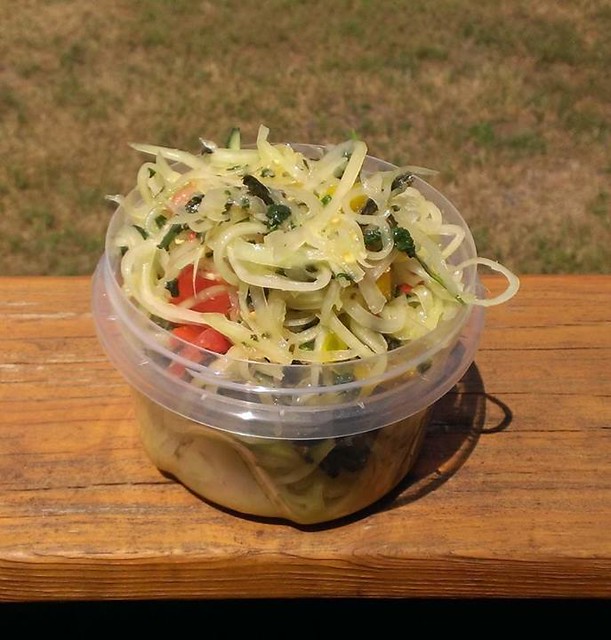
If you haven't had it, both "papaya" and "salad" are a little misleading. It's almost like a coleslaw, and feel free to use it as one. The papaya used for it is green - unripe - and shredded before being pounded in a mortar and pestle with lime juice, fish sauce or other source of salt (plain salt or soy sauce is fine to keep it vegan), fresh herbs and seasonings, and often some other vegetables - blanched long beans are common, as are tomatoes and raw Thai eggplant. I tend to use just papaya and tomato for the vegetables - I want the papaya to provide all the texture.
Papaya salad comes from Southeast Asia - it's often on Thai restaurant menus, and is called som tam in Thailand - and is perfect hot-weather food, but like I said, don't feel you have to limit it to other Southeast Asian contexts. Have it on a hot dog. Have it with some boiled crawfish or shrimp. Have it with fried chicken or fish.
This is more about technique than recipe. The two key things are, of course, shredding and pounding the papaya. Well, and finding green papaya in the first place. An Asian market is your best bet, though the Market Basket here in suburban New Hampshire carries it now, so who knows. You may be able to find it already shredded - I used to be able to. If you can't, you can use a mandoline or a very sharp knife, but I tell you what, I am in love with the Kom Kom miracle knife:
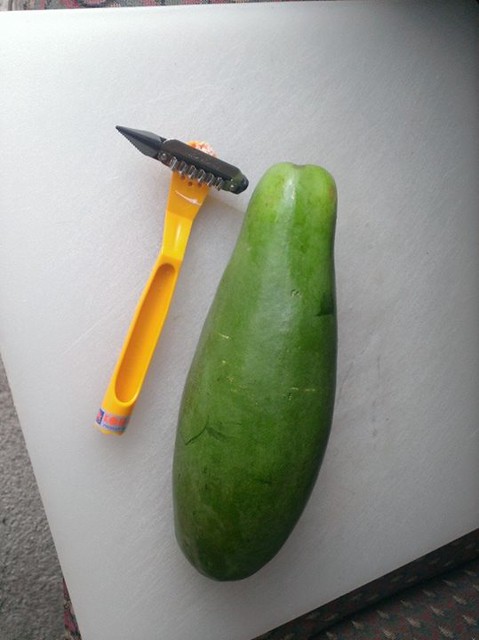
The Kom Kom works like a peeler - you pull it across the fruit (after you've peeled it, unlike the above photo) and instead of cutting away a layer of peel, it cuts thin julienned strips. Check it out:
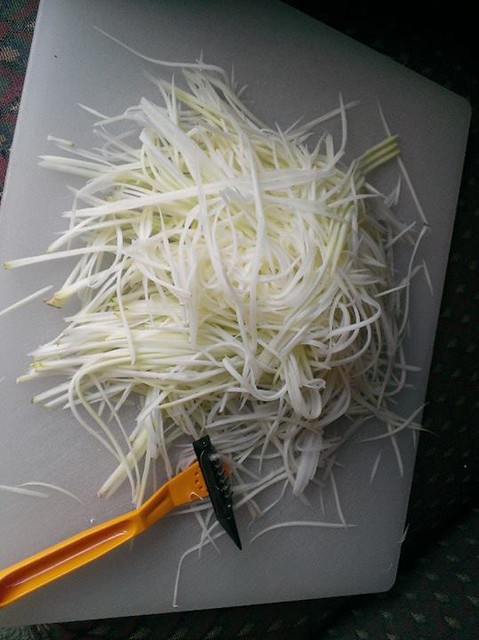
It took me a few years of occasionally trying to make papaya salad to realize that you really HAVE to pound it. You can't just toss the shredded papaya with the seasonings. Pounding it tenderizes the unripe fruit and lets the seasonings seep in. You'd be surprised how hard you can pound it without mashing it.
Ideally you want to pound it in a Lao-style clay mortar, the important aspect of which is that it has a narrow bottom and high sides, which is perfect for this. I know it sounds like I'm saying you need a lot of special equipment. And maybe you do! But a regular mortar and pestle will work too, just not as easily.
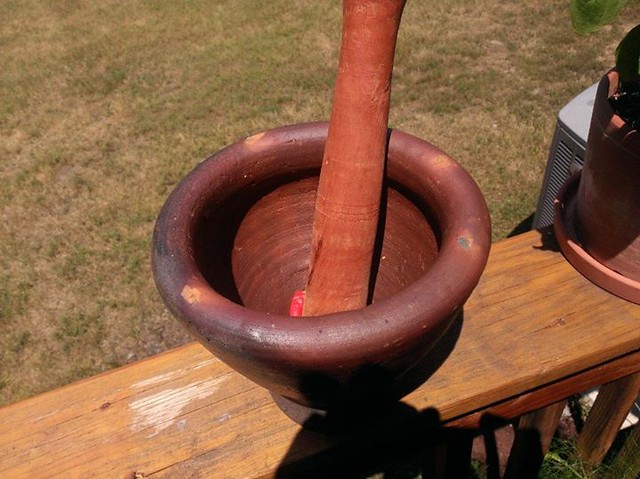
This is less than half of the shredded papaya in the mortar. It'll shrink down a lot once pounded:
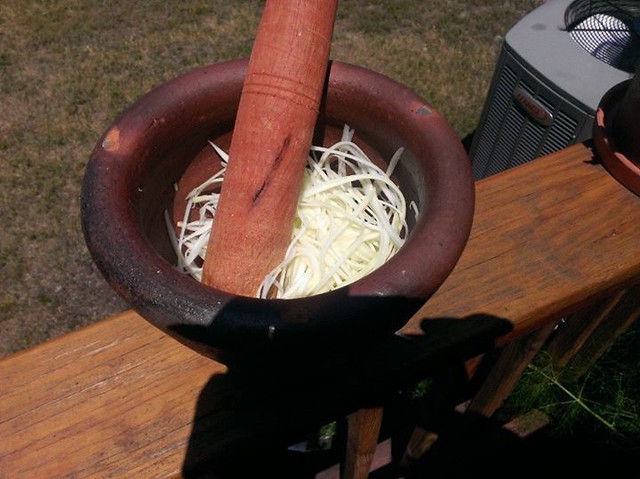
So everything about this is "to taste," but you want:
Fresh lime juice;
Fish sauce or other salt (salt, soy sauce, shrimp paste, crab paste, mud crabs);
Chile (I used a small red Thai chile);
Fresh herbs (mint, cilantro, culantro, and/or any basil - I also used sorrel this time, and was out of mint);
Other seasonings that appeal to you - I use ginger and lemongrass, garlic is common;
A little sugar;
Other vegetables if you like. I add a few cherry tomatoes. Parts of Thailand also add peanuts.
Pound the ingredients together, making sure the herbs are good and bruised, everything but the papaya (and long beans if you're using them) is pulverized, and the papaya is tenderized. There's a technique that this mortar lends itself naturally to of tossing the papaya a little with the pestle and then banging it against the side as it falls. Soon enough:
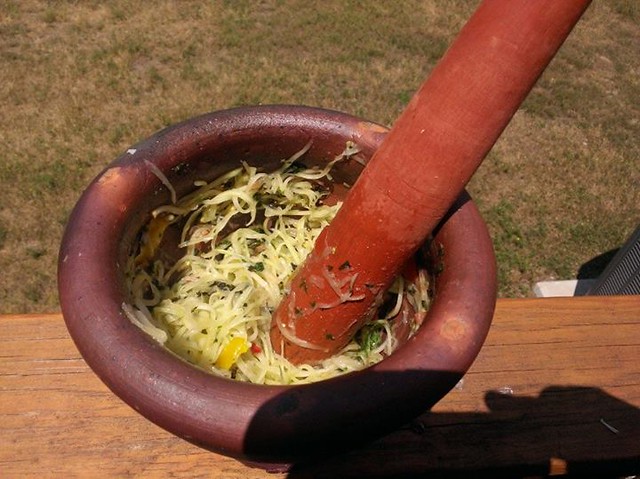
Tada.
You want the flavors balanced - a little tart, a little sweet, very green and herbal, a bit spicy (sometimes very spicy).
Maybe I'm hedging by saying "dish," so that sour cherries, fresh tomatoes, or whiskey can still be my favorite food, I don't know. But I'm telling you, papaya salad is way up there.
If you haven't had it, both "papaya" and "salad" are a little misleading. It's almost like a coleslaw, and feel free to use it as one. The papaya used for it is green - unripe - and shredded before being pounded in a mortar and pestle with lime juice, fish sauce or other source of salt (plain salt or soy sauce is fine to keep it vegan), fresh herbs and seasonings, and often some other vegetables - blanched long beans are common, as are tomatoes and raw Thai eggplant. I tend to use just papaya and tomato for the vegetables - I want the papaya to provide all the texture.
Papaya salad comes from Southeast Asia - it's often on Thai restaurant menus, and is called som tam in Thailand - and is perfect hot-weather food, but like I said, don't feel you have to limit it to other Southeast Asian contexts. Have it on a hot dog. Have it with some boiled crawfish or shrimp. Have it with fried chicken or fish.
This is more about technique than recipe. The two key things are, of course, shredding and pounding the papaya. Well, and finding green papaya in the first place. An Asian market is your best bet, though the Market Basket here in suburban New Hampshire carries it now, so who knows. You may be able to find it already shredded - I used to be able to. If you can't, you can use a mandoline or a very sharp knife, but I tell you what, I am in love with the Kom Kom miracle knife:
The Kom Kom works like a peeler - you pull it across the fruit (after you've peeled it, unlike the above photo) and instead of cutting away a layer of peel, it cuts thin julienned strips. Check it out:
It took me a few years of occasionally trying to make papaya salad to realize that you really HAVE to pound it. You can't just toss the shredded papaya with the seasonings. Pounding it tenderizes the unripe fruit and lets the seasonings seep in. You'd be surprised how hard you can pound it without mashing it.
Ideally you want to pound it in a Lao-style clay mortar, the important aspect of which is that it has a narrow bottom and high sides, which is perfect for this. I know it sounds like I'm saying you need a lot of special equipment. And maybe you do! But a regular mortar and pestle will work too, just not as easily.
This is less than half of the shredded papaya in the mortar. It'll shrink down a lot once pounded:
So everything about this is "to taste," but you want:
Fresh lime juice;
Fish sauce or other salt (salt, soy sauce, shrimp paste, crab paste, mud crabs);
Chile (I used a small red Thai chile);
Fresh herbs (mint, cilantro, culantro, and/or any basil - I also used sorrel this time, and was out of mint);
Other seasonings that appeal to you - I use ginger and lemongrass, garlic is common;
A little sugar;
Other vegetables if you like. I add a few cherry tomatoes. Parts of Thailand also add peanuts.
Pound the ingredients together, making sure the herbs are good and bruised, everything but the papaya (and long beans if you're using them) is pulverized, and the papaya is tenderized. There's a technique that this mortar lends itself naturally to of tossing the papaya a little with the pestle and then banging it against the side as it falls. Soon enough:
Tada.
You want the flavors balanced - a little tart, a little sweet, very green and herbal, a bit spicy (sometimes very spicy).
Wednesday, July 2, 2014
farmstands 7-2
Not much new to report except that local sweet cherries (Bings or close relatives) have been available for a few days and are very good this year. No raspberries or blueberries yet, though I expect them to be early.
Out in the garden, the fennel is getting crazy tall but the bulbs are still thumb-sized. I don't know if this means that, like with celery, fennel grows taller and bushier than you would guess from what you see in the supermarket, or if at some point the plant stops putting energy into growing stalks and starts putting it into developing the bulb.
Out in the garden, the fennel is getting crazy tall but the bulbs are still thumb-sized. I don't know if this means that, like with celery, fennel grows taller and bushier than you would guess from what you see in the supermarket, or if at some point the plant stops putting energy into growing stalks and starts putting it into developing the bulb.
Wednesday, June 18, 2014
farmstands 6-18-14
Just went to Kimballs for strawberries (3.50/small box), and they also had:
Garlic scapes (5.99/lb)
Green garlic, green onions (young onions), and scallions (1.99/bunch)
Heirloom tomatoes and cherry tomatoes ($4/box, obviously hothouse)
Diva cucumbers (2.99/lb, hothouse?)
Various greens (1.99/bunch) - no broccoli raab in evidence this time, probably just sold out
Rhubarb (2.49/lb)
Got a little of everything for $24, half of which was strawberries.
miti cana de oveja
I'll get a photo when I do a larger multi-cheese post, but I wanted to post about Miti Cana de Oveja, a Spanish cheese from Lorenzo Abellan. This is a fantastic cheese.
This week I made my annual birthday-celebratory shopping trip to Wegmans, returning with about a dozen different cheeses, most of them new to me (in addition to fresh wild halibut, flounder, grey sole, and monkfish; dry-aged steaks; MezzoMix soda from Germany; Kinder chocolates; Hartmann hot dogs; and Vegemite). We tried three of the cheeses last night - all three were fantastic, and all three will be blogged about.
But Cana de Oveja (I see it written without the "Miti" more than with, when I googled for information about the cheesemaker) is something of a Holy Grail cheese for me. For a long time, I've wanted to find "a sheep cheese that's like a goat cheese," meaning a young soft sheep's milk cheese that was like the sheep's milk equivalent of chevre. It's surprisingly hard to find, and I don't know enough about making cheese from sheep's milk to guess why. Sometimes traditions are just traditions - you probably could make mozzarella from goat's milk instead of cow's or water buffalo's, for instance, but you don't because those aren't the farmers who first made it.
Anyway, this is my cheese. This is the cheese I've been looking for! It looks exactly like a bucheron - a bloomy-rinded log with a thin brie-like layer surrounding the chalky white core - and it is so, so good. It's tangy, it's milky, and above all, it's sheepy. "Sheepiness" is a milder thing that "goatiness," but it's its own thing too - it's not "goaty, but less so," it's sheepy, and that's exactly why I've been searching for a cheese like this.
Instant favorite. Probably the best non-American young cheese I've had. I'm looking forward to trying it with some fruit or honey. Caitlin liked the richer, less tangy Castelbelbo, a mixed-milk from Italy, more than this, so perhaps I'll construct our cheese plates accordingly in order to sneak the lion's share of this stuff for myself.
Subscribe to:
Posts (Atom)