Monday, June 9, 2014

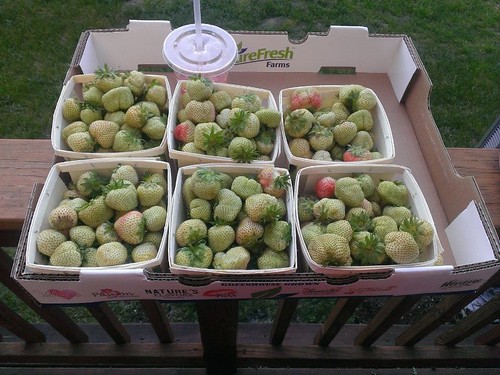
green strawberries

Green strawberries

Green strawberries aren't a new breed of strawberry like pineberries, they're exactly what they sound like: unripe strawberries. You see them once in a while at some farmers markets, but they're not nearly as common as green tomatoes or chiles - I had to make arrangements with Kimballs to have them picked for me.

The green is really attractive - a sort of ivory green before it starts to yellow as it ripens to red - though that color does not survive cooking the way the deep red of ripe strawberries does. This ivory color is actually a sort of intermediate stage - if you're picking your own, let the strawberries grow a bit to reach this stage rather than picking the fruit as soon as it appears. Those earlier green-green or "unripe unripe" as opposed to "ripe unripe" strawberries are harder with less flavor.

Why use green strawberries? Purely as a change of pace and to better understand the strawberry. It's not like with tomatoes, where cooking green tomatoes is a good way to deal with the glut of red tomatoes you would otherwise have, or a way to use those tomatoes you get at the end of the season that won't have time to ripen.

However, there are some similarities to green tomatoes, mainly that, compared to ripe strawberries, green strawberries are firmer and more tart. The strawberry flavor is still there, just fainter and without the sugar to bring it out. There's another flavor too, which I guess is the flavor of the chlorophyll or whatever's making them green, a flavor that goes away when the strawberry ripens.

So what do we do with these.

The first thing I did was macerate some overnight with some sugar to make preserves - same basic method I use for ripe strawberries: macerate overnight, heat up until they just start to soften, turn off heat, let sit overnight, add more sugar and boil until jam-thick.
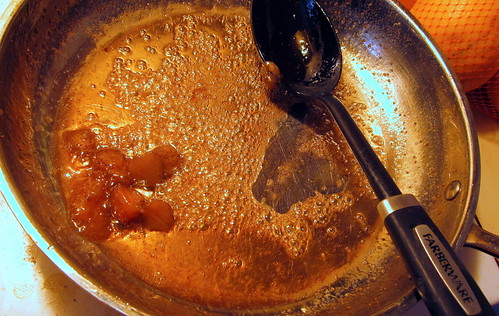
Green strawberry preserves

The ivory green is gone. The syrup of the jam is a color somewhere between golden raisins and cream soda, and the chunks of fruit show up in colors the paint swatch people might call Sun Belt Peach, Burnt Mountain Dew, and Foreclosed Lawn. It's a tart jam, but it's also surprisingly complex in flavor - far more than green tomatoes can yield, for instance, another difference there.

I've got more green strawberries in a jar of whiskey to make green strawberry bounce, some mixed with rhubarb for a pie, and some macerating in sugar to make green strawberry shrub. Tonight we'll have sliced raw green strawberries in salad and see how that goes.

Friday, June 6, 2014

farmstands 6-6-14

Finally the produce season is getting going. We've got our garden set up - tomatoes, fennel, and greens are doing great, lime basil mysteriously died, lovage and lavendar and sorrels (red and green) are doing pretty well. I just transplanted a Cuban oregano plant that the jury's still out on.

Rhubarb has come and will soon be gone at my mother's. By far the best thing I've done with it is this cake. Yes it has Jello. Yes it has marshmallows. It is fantastic.

The first local vegetables are starting to show up: radishes at Lull's today, green onions and broccoli raab (so much younger and sweeter than supermarket raab!) at Kimballs last weekend, and Caitlin picked up microgreens and white Japanese turnips (hakurei?) at the Copley Square Farmers Market today. I haven't tried those yet because she's actually not home yet, but turnips are wildly underrated, and I'm intrigued at trying a new-to-me variety.

This is also a good time of year for us (and anyone in this part of New England) to keep an eye on Valicenti Organico, a local (six minutes away from me) producer of pastas and sauces. We buy their ravioli regularly, which leans heavily on local fruits and vegetables. The ratatouille ravioli is one of my favorites, but at the moment we have two that we haven't tried yet: artichoke and boursin, and even more excitingly, pea tendril with grilled ramps and local mushrooms, which is three of my favorite vegetables in one ravioli.

It'll be another couple weeks before strawberries - I've requested some green strawberries from Kimballs in the meantime - and a few weeks after that before blueberries and early season vegetables. Tomatoes, forget it, not for ages.

chicken riggins

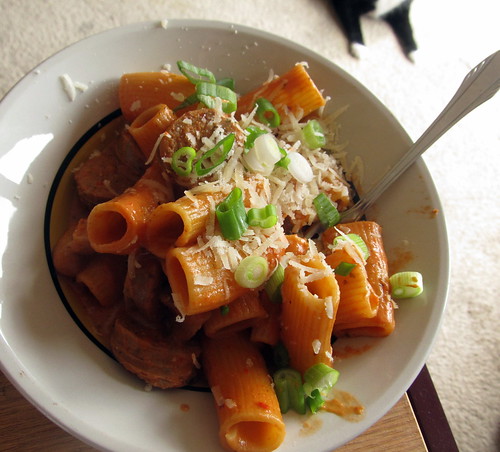
I was aware of, but had never had, chicken riggies - an upstate New York dish of chicken and rigatoni with a creamy tomato-pepper sauce. But I added some sausage to mine and named it after Caitlin's favorite football player. Very good stuff, very flavorful, and made good leftovers for lunches.

Chicken Riggins

Chicken Riggins

1 can (28 oz) San Marzano tomatoes. San Marzano tomatoes are rich, low-acid plum tomatoes, which are perfectly-suited to long-cooked red sauces like this one.
2 red bell peppers, stem/ribs/seeds removed.
3 cloves garlic.
1 small onion, chopped.
1 tablespoon sriracha or similar hot sauce (no vinegar, no lemon, no cumin)
1/4 cup dry vermouth
1/2 cup heavy cream
salt and herbs to taste - marjoram, oregano, fennel

4 chicken thighs, just the meat, chopped. You can often buy boneless skinless chicken thighs, but I would get the bone-in skin-on kind and make stock with what you don't use.

4 green onion sausages

rigatoni

fresh parmesan, grated, and green onions, sliced. We both agreed that using the good parm made a noticeable difference here.

Simmer the tomatoes, bell peppers, garlic, onion, sriracha, and dry vermouth together, covered, until the vegetables are very soft; blitz with immersion blender, cook down uncovered, slowly, until thick; add cream and seasonings, cook another half hour, and adjust seasonings if needed.

Meanwhile, toss the chopped chicken with a little Tony Chachere's seasoning salt and saute until cooked. Cook sausage links and slice. Drain fat if necessary and add meats to sauce.

Cook the rigatoni, finishing it in the red sauce the last 2 minutes, and serve with parmesan and green onions.

Friday, May 9, 2014

what we blog about when we blog about butter

I keep saying "I need to blog about this, I need to blog about that," and never getting around to it, so here are some half-formed thoughts on butter that I haven't had a chance to follow through on yet:

THOUGHT 1: A couple weeks, maybe a couple months ago, I read about a chef who had made butter by combining cream with a soft ripened cheese (Camembert maybe?) in a 9:1 ratio, let the cream culture, and then churned it. I don't know exactly how Camemberty (maybe?) the butter came out, or if the cheese is just used as the source of the culture to culture the cream, BUT. It got me thinking about ways to manipulate cream before you churn it.

I've made butter before. I first started buying good dairy when I moved to Indiana and the farmers' markets (and many local stores) carried it, about 11 years ago now (geez). Good pasteurized cream makes decent butter and is a good exercise; cultured cream (adding a little buttermilk and letting it sit at room temp overnight) makes even better butter, though pasteurization does make it a little resistant to culturing. Anyway, if you have an immersion blender, making butter is as simple as whipping cream and continuing to whip it until it breaks into solid butter and liquid whey. If you don't have an immersion blender, well, it's still that simple, your arm will just be more tired.

So when thinking about ways to manipulate cream pre-butter, there are two limits you have to impose:

1a: The cream still has to be able to be turned into butter. That means you can't do anything that'll curdle it, like adding lemon juice, and you can't dilute the fat content (you can whip milk all day and you won't get butter, just warm milk). Does it mean you can add a liquid as long as you keep the fat percentage the same, such as by adding bacon fat? I don't THINK so, but I don't know for sure. If you add another fat, will it end up as part of the butter or leak out with the whey? I don't know that either.

1b: There is no point in manipulating the cream towards a different butter if you can get the same results by manipulating the butter. For instance: you can add cinnamon to cream and whip it into butter, but it won't be different from, or better than, adding cinnamon directly to butter. This is particularly key when you're forced to use pasteurized cream, because it means the best storebought butter is better than your homemade butter, so the best manipulated butter will only result from manipulated cream when manipulating the cream is the only way to reach the final product in question.

I think there are three basic forms of cream manipulation to be considered and explored: adding an ingredient (cheese, for instance), infusing the cream with an ingredient that is steeped and then removed (bay leaves, for instance), and changing the cream by other means (such as by smoking it or culturing it).

I thought about ramp butter made from ramp-infused cream, which invokes the 1b issue: will this be different from ramp butter made with ramps added directly to butter? Yes. Will it be significantly different? I don't know. Will it be better? I don't know. Even moreso that garlic, ramp mellows out when it cooks. We could be talking about something surprisingly subtle here.

THOUGHT 2:

This led to a consideration of fat manipulation and the manipulation of fats used in cooking.

I've made root beer flavored butter before, using Root from Art in the Age. It was made via fat-washing, wherein you add a fat to an alcohol, give it some time, and they trade flavors, because everything alcohol-soluble is also fat-soluble and vice versa. So, if you want butter-flavored Scotch, you end up with both that and Scotch-flavored butter. This naturally invites questions about what to do with the yin once you've created the yang you were looking for.

Thinking about ramp butter got me thinking about using fat washing to flavor butters rather than liquors, such as butter that's been fat-washed in Angostura bitters to make bitters butter to put on, for instance, cinnamon toast (or hamburgers or corn on the cob or who knows!) How bitter would the butter be? Would it take up all the flavors of the Ango equally, or would they wind up in a slightly different mix? This needs to be played with.

That led to thinking about other fats that could be flavored with liquor, and other ways of using them. The flavored butters are condiments, but what if we flavored a fat that we cook with? If we made bourbon-flavored lard, could we fry chicken in it, or would the heat (which is half again as hot as your hot toddy) destroy the bourbon flavors? If it didn't destroy the bourbon flavors, how much would those flavors flavor the chicken, and how would the final product differ from chicken marinated in bourbon?

Bourbon fried chicken is the obvious killer app here, but that's just my brick road, that's where my feet go, there are other places to check out too.

What about vermouth-infused olive oil?

What about making biscuits, pie crust, or pastry dough with an alcohol-flavored fat?

And so on.

Much to do, clearly.

Wednesday, April 2, 2014

meat days

One day a week, more or less, the Lenten fast goes on hold. I'm not doing it for religious reasons, so for me that day's not always Sunday. Some meat highlights:

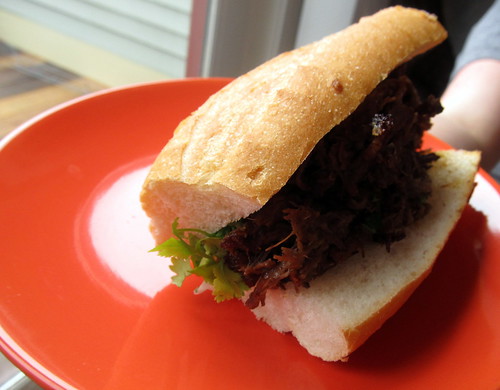
Rendang poboys:

I had ordered live crawfish to boil, and while I was at it, had them throw in some poboy bread since the shipping charge was the same either way. I haven't had real poboy bread in ten years, man. It makes a difference.

Rendang poboy

The idea here was to do something like New Orleans' roast beef poboys - wherein a chuck roast is braised until it's falling apart, and served on the sandwich complete with its thick flavorful gravy - but to nudge the flavors in a different direction.

I braised a 4 pound chuck roast (after browning in coconut oil) for about 3 hours in one can of coconut milk, a full tube of lemongrass paste (six stalks' worth of lemongrass, according to the label - lemongrass is such a pain in the ass that I have no qualms using the convenience version), a squirt of sriracha, and a paste made of two shallots, six cloves of garlic, about a cubic inch of fresh ginger. Seasoned everything with a little cumin, a little ground coriander, a little ground nutmeg, and fish sauce to taste (rather than salt). Once the beef was falling apart, I removed it, let the sauce continue to cook down until it started to sputter as the coconut oil started to break out, shredded the beef, and added it back in to coat it and slightly fry it.

Served it on the rolls with chopped cilantro, shallots, and mint. Fresh tomato wouldn't be out of the question.

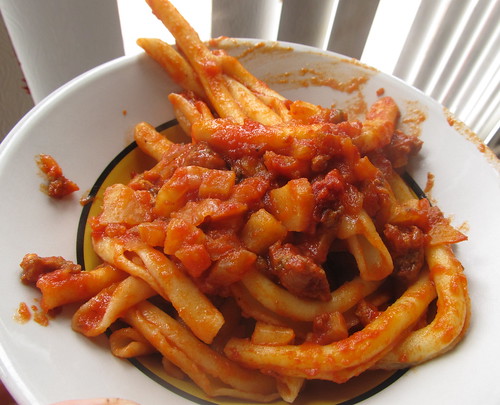
Chaurice-celeriac tomato sauce.

I'm a sucker for pasta sauces that use both tomato and seafood stock, but the thing is, I'm not a big fan of the ones with a ton of seafood in them. I like the seafood stock to provide a backbone. You could certainly add clams, crawfish, or shrimp to this, but it's much more subtle and interesting without them. Chaurice is a Louisiana sausage that comes both fresh and smoked and gets its heat from jalapeno, with a little vinegar. Do not be fooled by the similarity in name to chorizo or chourico - they are not the same. Hot Italian sausage wouldn't be the same either, but it'd be good, and it's easier to find.

Brown about six ounces of fresh chaurice (bulk, or removed from link casings) with some sliced onion or shallot. Add half a cup of peeled diced celery root (celeriac) and a couple cloves of smashed garlic, and a can of tomatoes, pureed (the smaller ones, not the 28 oz). Add a couple cups of crawfish stock (crawfish shells covered in water and simmered for an hour, then strained) - the sauce should be way too thin at this point. Cook it down until it isn't - 3, 4 hours. Add a spoonful or two of vermouth and check for salt, though there's a good chance you won't need it, between the sausage and the crawfish stock.

The flavor profile here is kinda like a Bloody Mary, kinda like Old Bay. I served it on strozzapreti.

Chaurice/celeriac tomato sauce

Monday, March 17, 2014

eastern standard and the hawthorne

A couple weeks ago, Caitlin and I took a "freelancer's weekend" - Wednesday through Friday - in Boston, to do some of the things we'd meant to do and never got around to when she actually lived there, like the Aquarium (disappointing compared to New Orleans) and the MFA (fantastic). Blog-relevant: our lunch at Eastern Standard and drinks at the Hawthorne, both of which are located in our hotel, the Hotel Commonwealth.

Eastern Standard was crowded as shit, and our first attempt to eat there failed - we were tired and hungry, the place was packed, it was freezing cold, and there was a half hour wait. We tried again for lunch the next day - still packed, but there was a free table.

Cheese Plate

We started with the cheese plate, and I have an awful memory for cheese plates and always wish they came with a card to remind you what you've eaten. The sheep's milk and semisoft cheeses on the left and middle were great; the blue, well, I was able to finish it, but ought to remember to specify "no blue" when I order cheese plates.

Chocolate-cardamom egg cream; guayaba arabica (rum, guava, coffee)

The chocolate-cardamom egg cream Caitlin ordered was a highlight of the weekend, but my rum drink - Guayaba Arabica, Naomi Levy's award-winning combination of rum, guava nectar, coffee syrup, lime juice, and cilantro - was terrific too.

Pork belly, escargots, pickled mushrooms

Our appetizer was small - my only complaint - but maybe the single best bite of food we had all weekend: cubes of pork belly paired with garlicky escargots, some kind of herb puree, and very tart pickled mushrooms. It was Caitlin's first encounter with escargots and my best - I've only had them on their own before, but paired with rich pork they were even better.

I did the "two apps as an entree" thing and went all-raw: oysters and steak tartare.

Oysters
Steak Tartare

Both were great - the steak tartare was just right, the right temperature, seasoned just enough, not too busy. It's easy to get steak tartare wrong, especially these days when it's fallen out of favor.

Caitlin had the moules provencal, which were nice and fennelly.

Moules Provencal

We went to the Hawthorne twice - once for late-night drinks our first night there, and then just after opening the next night, for drinks and "a dinner of snacks." We were waited on mainly by Amanda (both nights), but also talked to, and were brought drinks by, bar manager Jackson Cannon.

The Hawthorne
The Hawthorne's menu

The Hawthorne serves mainly small plates, as you can see. It's a great space - really comfortable and low key, with great people. They treated us very well, and comped us some of our food and two drinks both nights. Not pictured are the pretzel nuggets we had with beer mustard, after our initial deviled eggs and mixed pickle plate:

Pickle plate and deviled eggs
That's pickled brussels sprouts, pickled cranberries, pickled mushrooms, pickled chickpeas, and I think I'm forgetting something. Turnip or something?

There's no way I'll remember what order we had our drinks in:

Naked and Famous
Mine. The Naked and Famous: mezcal, Aperol, chartreuse, lime. I have so much trouble mixing with mezcal myself, and Caitlin isn't a fan of it or tequila so I've stopped putting much work into it, but this was great.


Hanky Panky
Mine. Hanky Panky (gin, Fernet, vermouth). A classic, well-executed.

Amaro Nardini and soda
Mine. They had a lot of amari I hadn't tried and can't buy in New Hampshire, so I decided to try one of them, Nardini, with soda water.

Rum drinks: Marshall Islands swizzle, "something bitter with coffee liqueur"
Rum drinks. Caitlin's on the left - a Marshall Islands swizzle, with rum, ginger, honey, and lime juice. They really know what they're doing with ginger at the Hawthorne - that informed one of my later choices. My drink here was a special request - "something bitter with coffee liqueur in it." I think they used Campari, but I don't remember for sure.

Improved Bamboo Cocktail
The Improved Bamboo cocktail, one of our comped drinks they thought we'd like. Sherry, dry vermouth, and sweet vermouth. My first sherry cocktail, and it was fantastic - one of the best drinks we had.

Framboise Sour
Special request by Caitlin: something with the framboise eau de vie they listed in the menu. I suggested a basic sour - they went the extra mile by incorporating egg white. It focused the raspberry flavor perfectly.

"Something with ginger and Campari"
Mine. "Something with ginger and Campari." I don't know what else ended up in there, but it's so good.

Fino Swizzle
Mine. The Fino Swizzle - cognac, port, cherry syrup, lemon juice, sherry, and bitters. So so good. How are the sherry drinks the best drinks? Why haven't I been paying attention to sherry drinks?

I apparently didn't get a photo of Caitlin's Phil Collins, but it was really good - cucumber vodka, lime juice, simple, and chartreuse, topped with soda. Could drink those all summer.

Since it's St Patricks Day, I ought to also mention Irish whiskey! I haven't got a photo of it, but I recently picked up a bottle of Tullamore Dew Phoenix, and it's a fantastic whiskey - my favorite new whiskey in years, incredibly smooth given the 110 proof.

Thursday, February 20, 2014

smothered duck and cabbage

This is my eighth winter back in New England, unfortunately, and one of the things I always said was that usually the way winter works here is, if it's super-cold, at least you don't get as much snow; if it's super-snowy, at least it's not as cold. I swear it was a good rule of thumb - there's such a thing as too cold to snow, after all, and New Hampshire gets that cold without much work. But this year, this year decided to prove me wrong - the National Weather Service said today that NH had both a snowier winter than average and a colder one.

Welllll fuck that.

I know it's almost the end of February, but there is a mountain of snow outside, we've had four noteworthy storms in the last, what, week and a half, I've been rear-ended by a car that was slipping and sliding on the snow and couldn't stop in time, I've driven through town half-blind because ice was forming on the windshield faster than the wipers could remove it, and those wipers are themselves now shredded to pieces as a result.

So we made some winter food. Some really really wintry food. Stick to your ribs.

Smothered duck and cabbage

The principle of smothering anything is really simple: you cook it with just enough liquid to keep it from sticking, until it's very tender. It's a fine line between smothered X and braised X or X stew, but if I hear "braised," I think more added liquid than "smothered," and if I hear "stew," I think "thickened," whether by a roux, cream, or the starch from added ingredients.

In this case, this is smothered duck and cabbage, which takes a little more doing than usual: I started with a whole duck, cut it into pieces, and because this is a domestic duck, it has a hell of a lot of fat on it. Cutting slits in the skin, sprinkling salt on, patting dry, waiting a couple hours and patting dry again, and then browning every piece resulted in cooking off a full pint of duck fat, before continuing on.

In the meantime, I chopped up a red cabbage, sprinkled it with salt and left it in a colander, and rinsed the salt off after the duck was done. Just helps it cook by getting some of the water out.

Everything else? One bunch of young carrots, the kind sold with tops on. One onion, halved and sliced. A handful of celery leaves, sliced up. Chicken-duck-garlic stock, made with chicken thigh bones, chicken wing tips, garlic cloves, and the duck neck - just stuff I happened to have left over. Some hot sauce. Plenty of salt.

Browning the duck is very important, and then the duck is removed to a platter, the fat is removed, the vegetables are briefly sauteed in the same pan, and the duck and veggies go into a cast iron Dutch oven in layers. Barely fit.

A couple hours in the oven at 350 and boom, all set.